Manga Translator

Add your manga pages

Translate speech and thought bubbles on a manga or webtoon page. Compare the dialogue panel by panel and save the translated PNG.

JPG, PNG, WebP · 10 MB each · 5 credits per image

Japanese manga

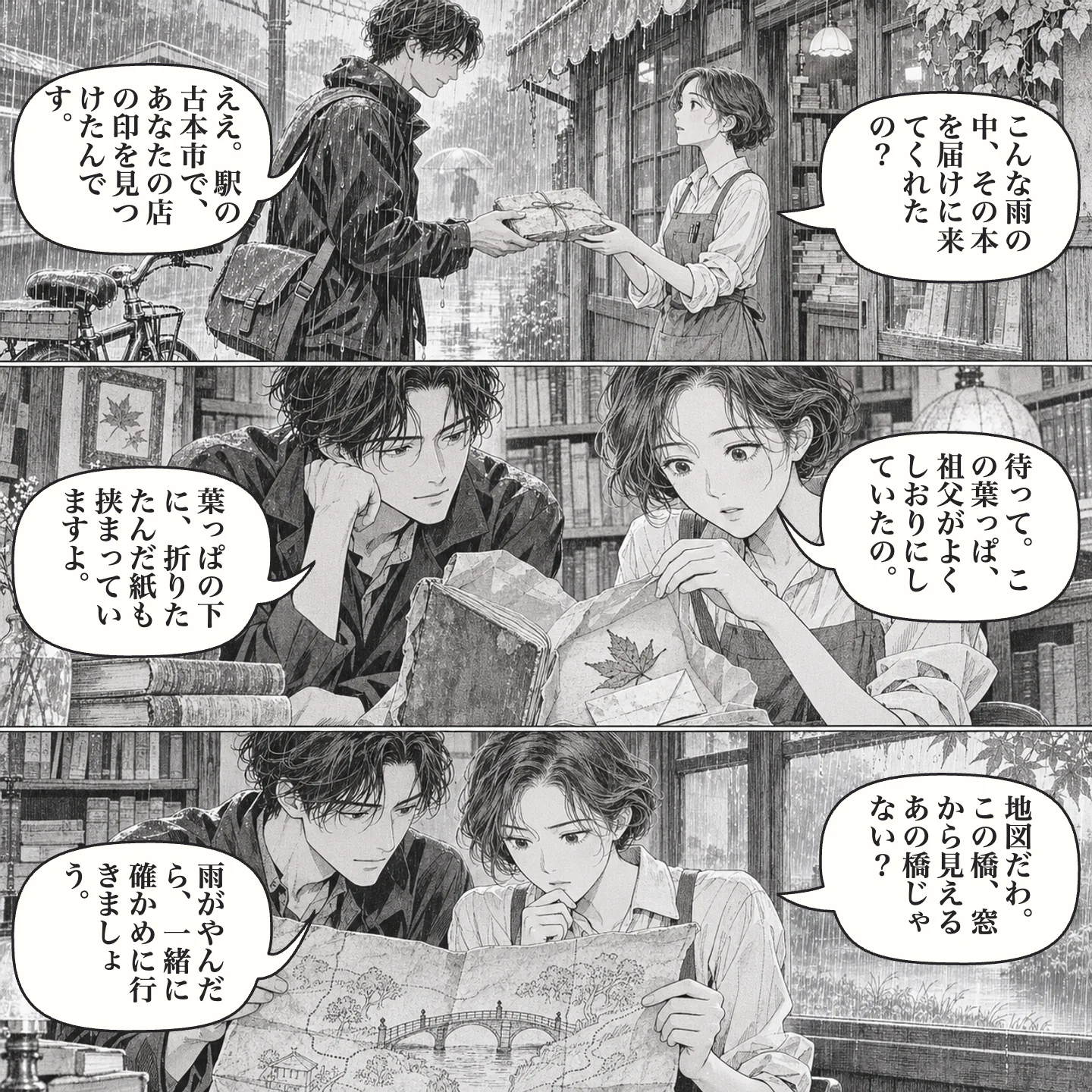
A book, a pressed leaf and a hidden map.

Follow the six speech bubbles from the upper right. This manga translator example shows how a Japanese exchange between a courier and a bookseller reads in English, panel by panel.

In the middle panel the bookseller recognizes her grandfather’s bookmark. The courier notices a second clue underneath. Move the divider over both speakers to see how vertical Japanese becomes horizontal English in the same space.
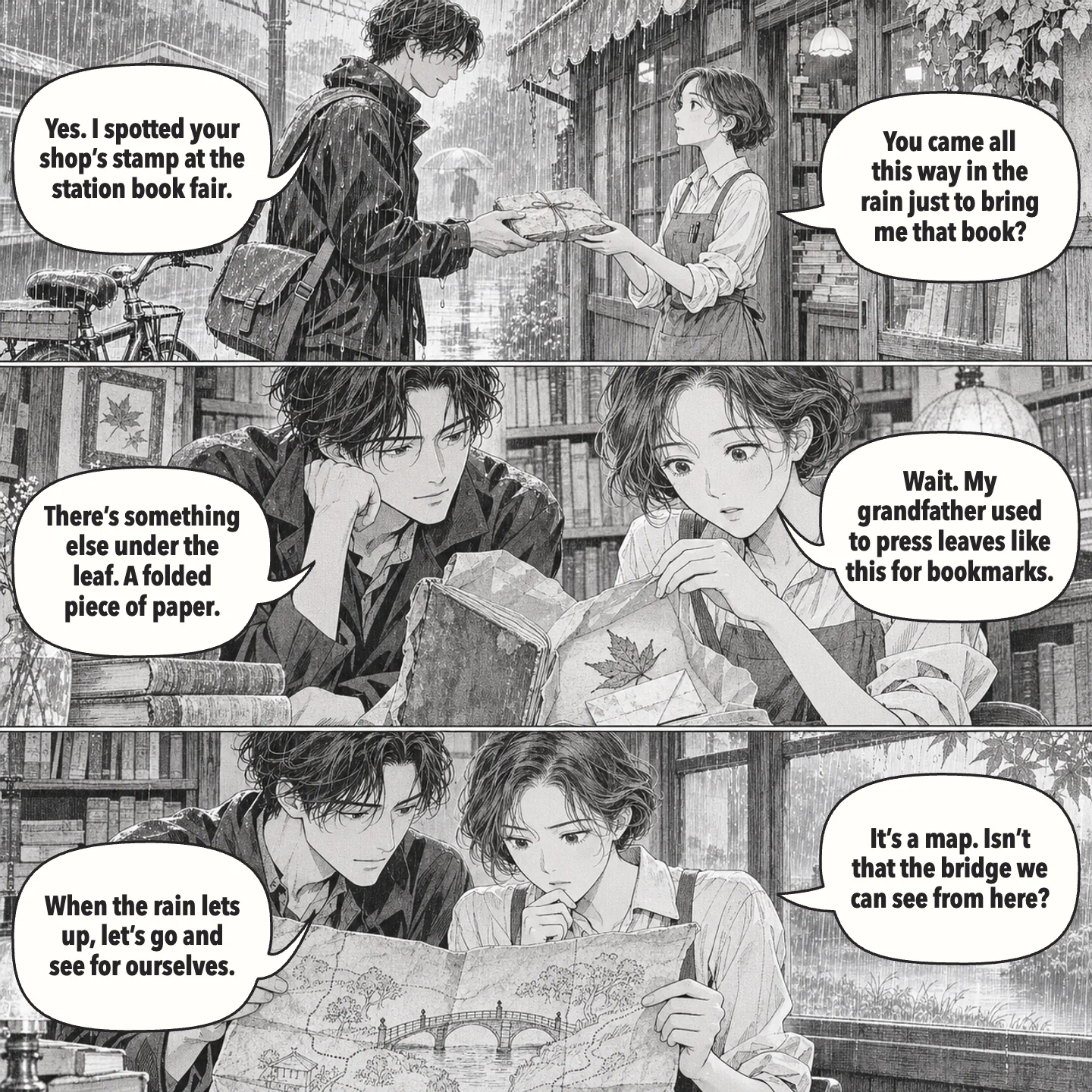
The letter in the book translated into English
The letter in the book in Japanese
Original · JapaneseEnglish · Translated

The letter in the book · Panel 1 · Bookseller

こんな雨の中、その本を届けに来てくれたの?

You came all this way in the rain just to bring me that book?

How to translate a manga page

  1. Bring a page

    Drop in a scan, paste a screenshot or open a direct image link. Keep the whole exchange in the frame so a reply has its question.

  2. Choose a reading language

    Set the target language and sign in with Google. Leave the source on Auto detect or choose it yourself, then start the translation.

  3. Read the exchange

    Open Compare and slide across the balloons. Follow each tail to its speaker, then download the finished page as a PNG.

Which words does the manga translator change?

Read the shape around the lettering. It tells you whether a word belongs to a character’s voice, an inner thought or the world behind them.

Speech balloons

Wait for me!

Spoken dialogue is translated inside its balloon. The tail identifies the speaker.

Thought bubbles

Did I miss it?

An inner voice gets its own translation. Dotted trails and cloud shapes help you follow whose thought it is.

Lettering in the artwork

CLACK

A train’s sound effect, a platform sign and a narrator’s caption sit outside the dialogue and are left in the scene.
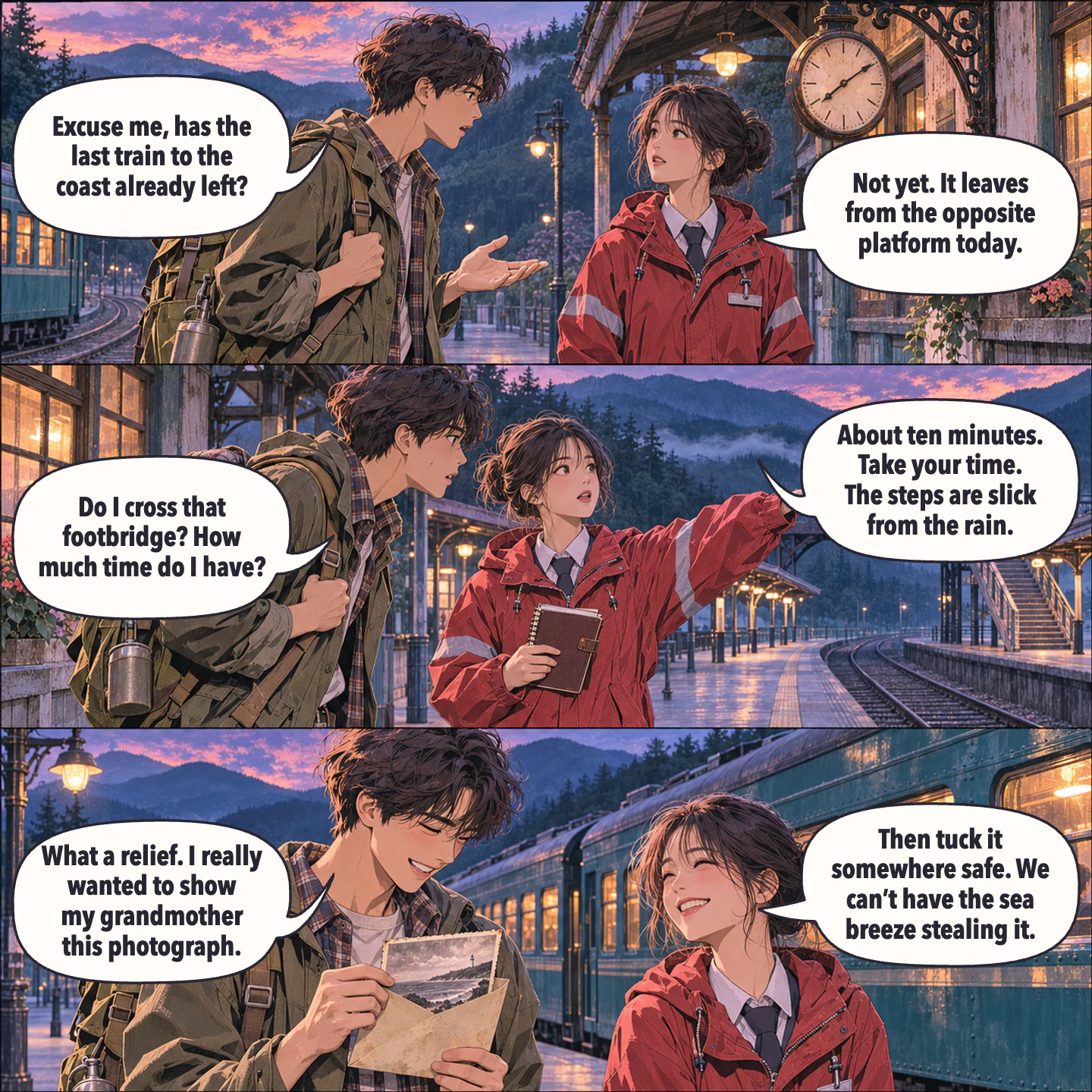
The last train translated into English
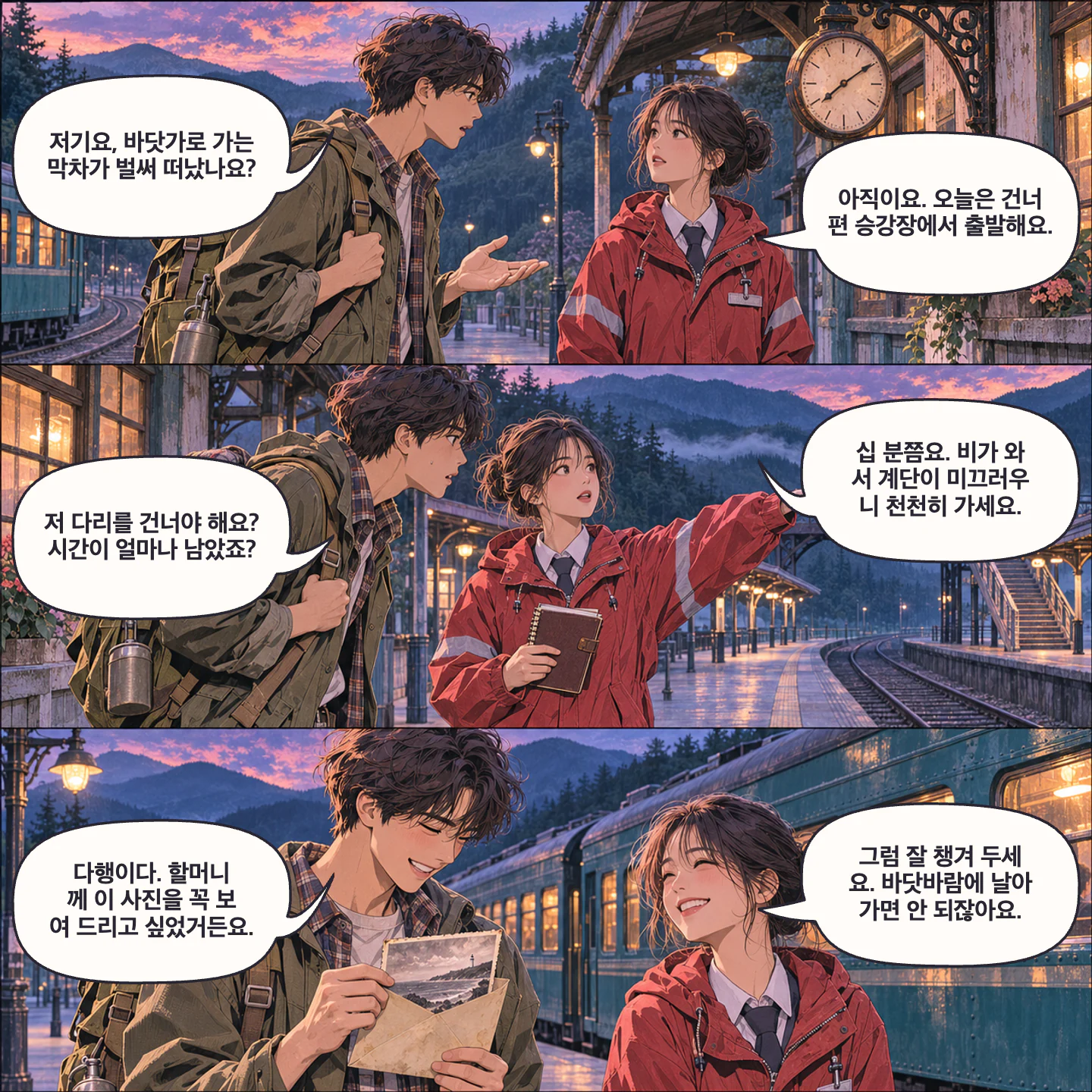
The last train in Korean
Original · KoreanEnglish · Translated

The last train · Panel 1 · Traveler

저기요, 바닷가로 가는 막차가 벌써 떠났나요?

Excuse me, has the last train to the coast already left?

Korean webtoon · The last train

Translate Korean webtoon dialogue across three panels

The traveler thinks he has missed the last train. Read his first two questions together. He needs to know which platform to reach and how much time he has. The attendant’s calm reply gives him a reason to slow down.

십 분쯤요. 비가 와서 계단이 미끄러우니 천천히 가세요.

“About ten minutes. Take your time. The steps are slick from the rain.”

In panel three, the photograph explains his hurry. Check that the English keeps the family connection and the attendant’s gentle joke about the sea breeze.

French comic · The lighthouse lookout

A sequence hidden in the dialogue

An astronomer and an apprentice watch a lighthouse. The small words carry the clue. Change the number or order of the flashes and the boat’s answer in the final panel stops making sense.
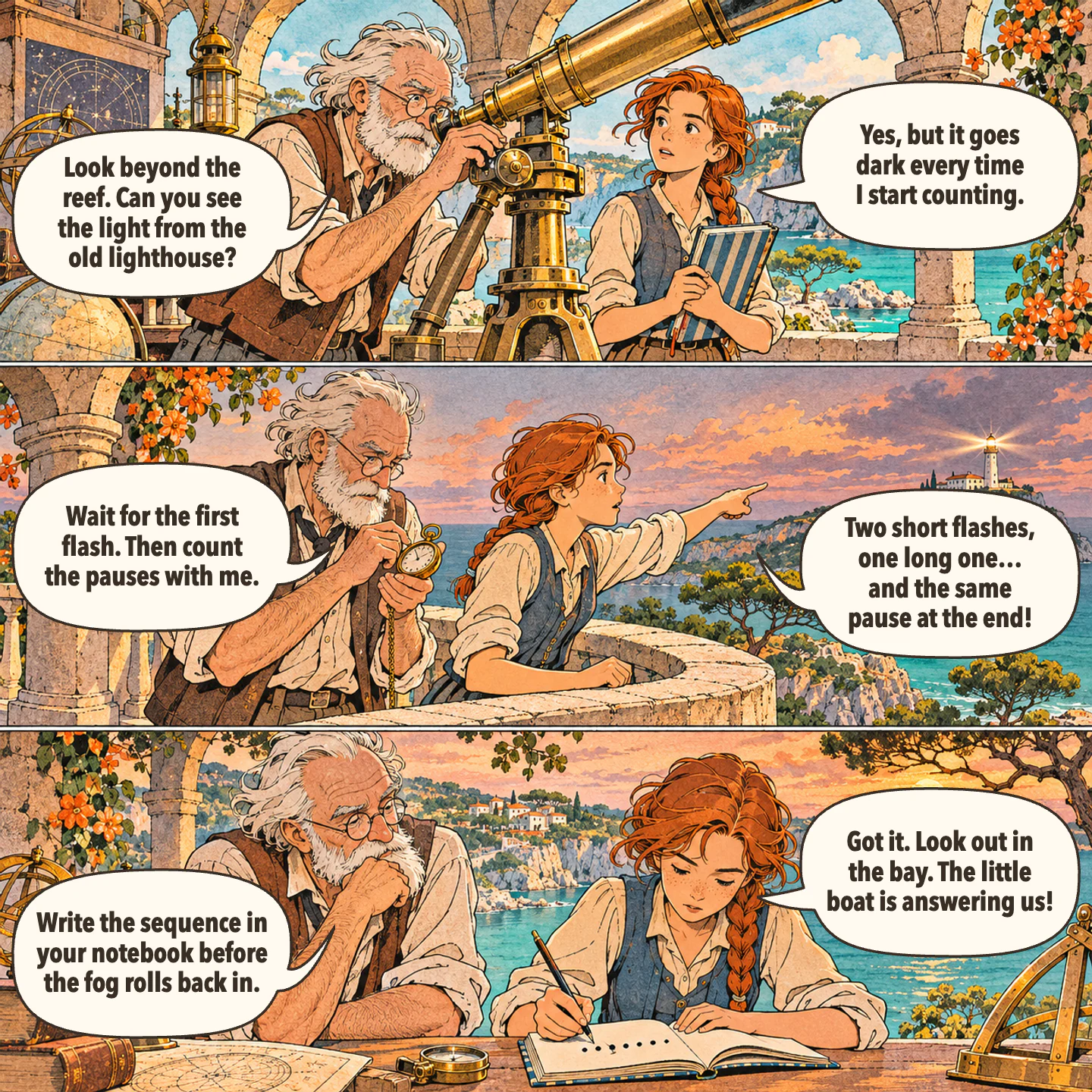
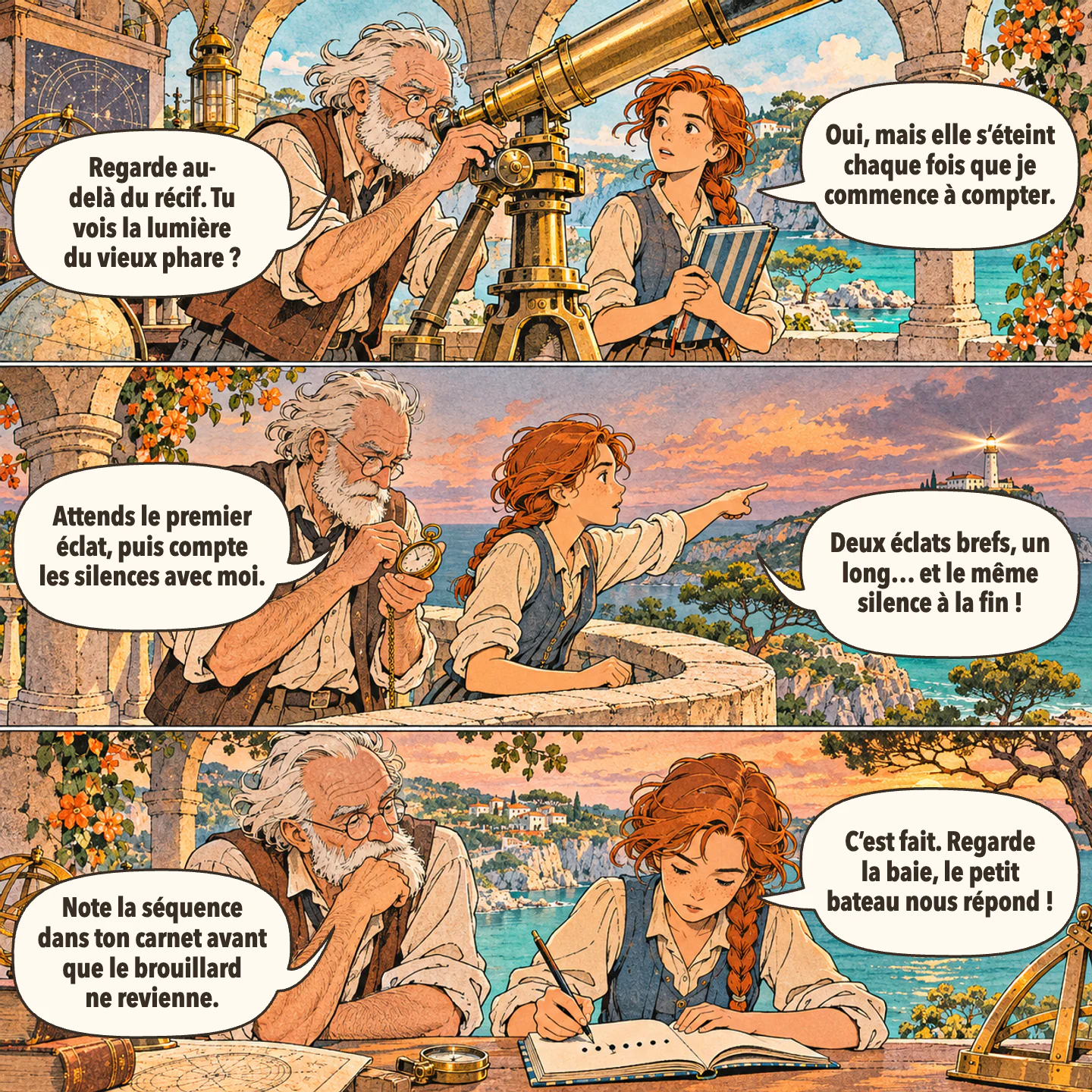
  1. Find le premier éclat, the first flash. The astronomer is telling the apprentice when to start counting.
  2. Read deux éclats brefs, un long across the line break. The two short flashes come before the long one.
  3. Look at the last tail. The apprentice spots the boat’s reply while the astronomer is still thinking about the notebook.
The lighthouse lookout translated into English
The lighthouse lookout in French
Original · FrenchEnglish · Translated

The lighthouse lookout · Panel 1 · Astronomer

Regarde au-delà du récif. Tu vois la lumière du vieux phare ?

Look beyond the reef. Can you see the light from the old lighthouse?

Choose your reading language

Choose a language to set it on the canvas. The page keeps its panel order, including right-to-left manga.
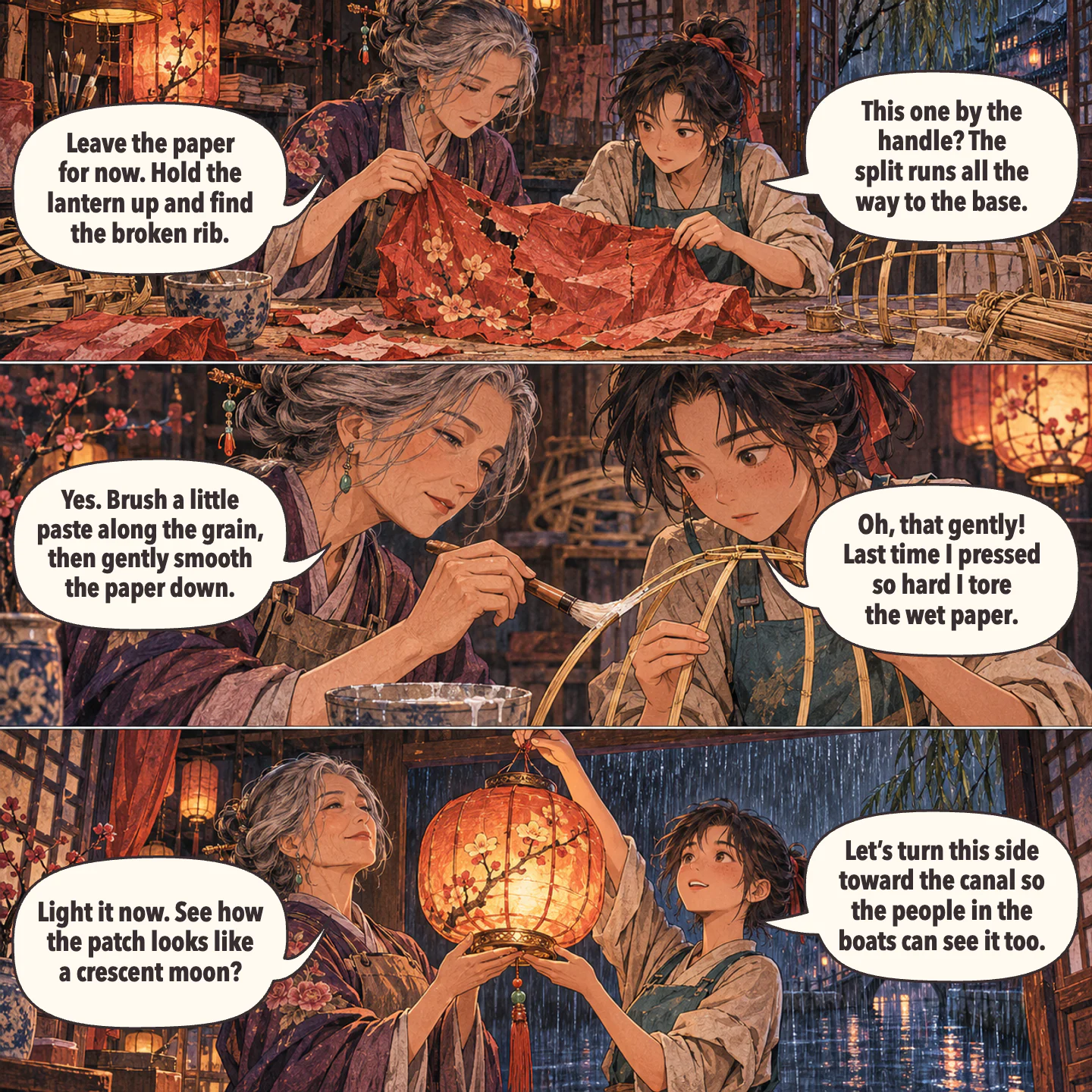
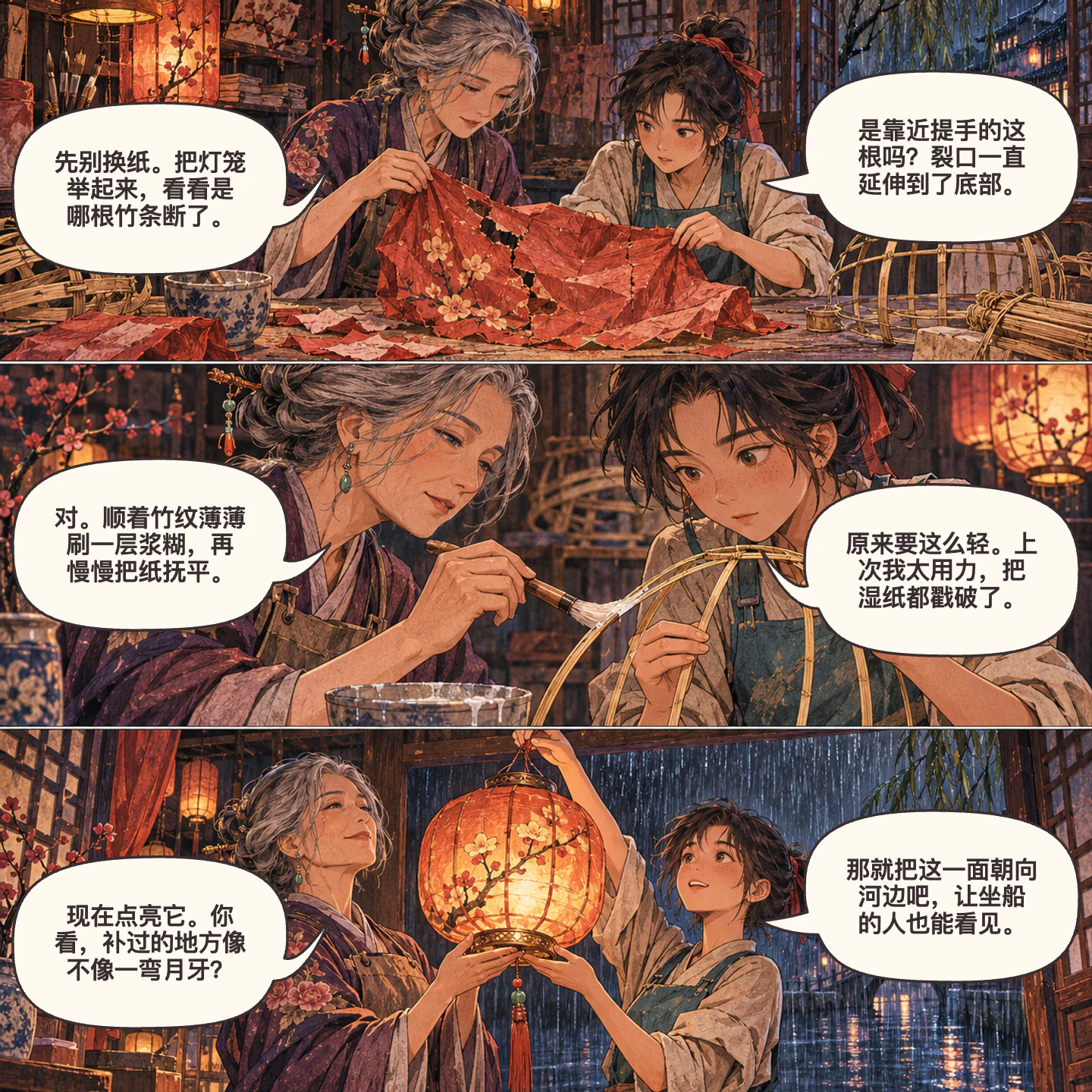
The paper lantern translated into English
The paper lantern in Chinese (Simplified)
Original · Chinese (Simplified)English · Translated

The paper lantern · Panel 1 · Lantern maker

先别换纸。把灯笼举起来,看看是哪根竹条断了。

Leave the paper for now. Hold the lantern up and find the broken rib.

Chinese manhua · The paper lantern

Translate the craft as well as the words

A lantern maker teaches an apprentice to repair a split frame. The hands in the drawing help explain what the instructions mean. Read the first panel before deciding how to name the broken piece in English.

竹条 · bamboo rib
The apprentice points to the strip that supports the paper. “Rib” tells an English reader what the bamboo does.
顺着竹纹 · along the grain
Watch which way the brush moves. That direction matters when the apprentice tries the repair.

The final exchange shifts from instruction to imagination. The repaired patch becomes a crescent moon for passing boat passengers to see.

Choose a crop that keeps the story legible

Printed manga
Flatten the binding
Photograph the page straight on. Check the smallest vertical column near the spine before uploading.
Vertical webtoons
Cut between scenes
Split a long scroll in the space between panels. Keep a speaker and the immediate reply in the same crop.
Double-page spreads
Keep the exchange together
Use the whole spread when a balloon crosses the fold. Separate the pages if the lettering becomes too small to read.

JPG, PNG and WebP · Up to 10 MB and 24 megapixels per image

Spanish graphic novel · A song after midnight

Two people in a studio. A third in a letter.

The presenter assumes nobody is listening. The engineer produces an envelope from the local baker. In the next balloon, “she” means the woman who wrote the letter. Its tail still belongs to the presenter.

Para quien enciende el horno antes que el sol, va esta canción.

“For the one who fires up the oven before sunrise, this song is for you.”

Read the dedication aloud. The station has gone from a private conversation to a live broadcast, and the final line should sound like someone speaking into a microphone.
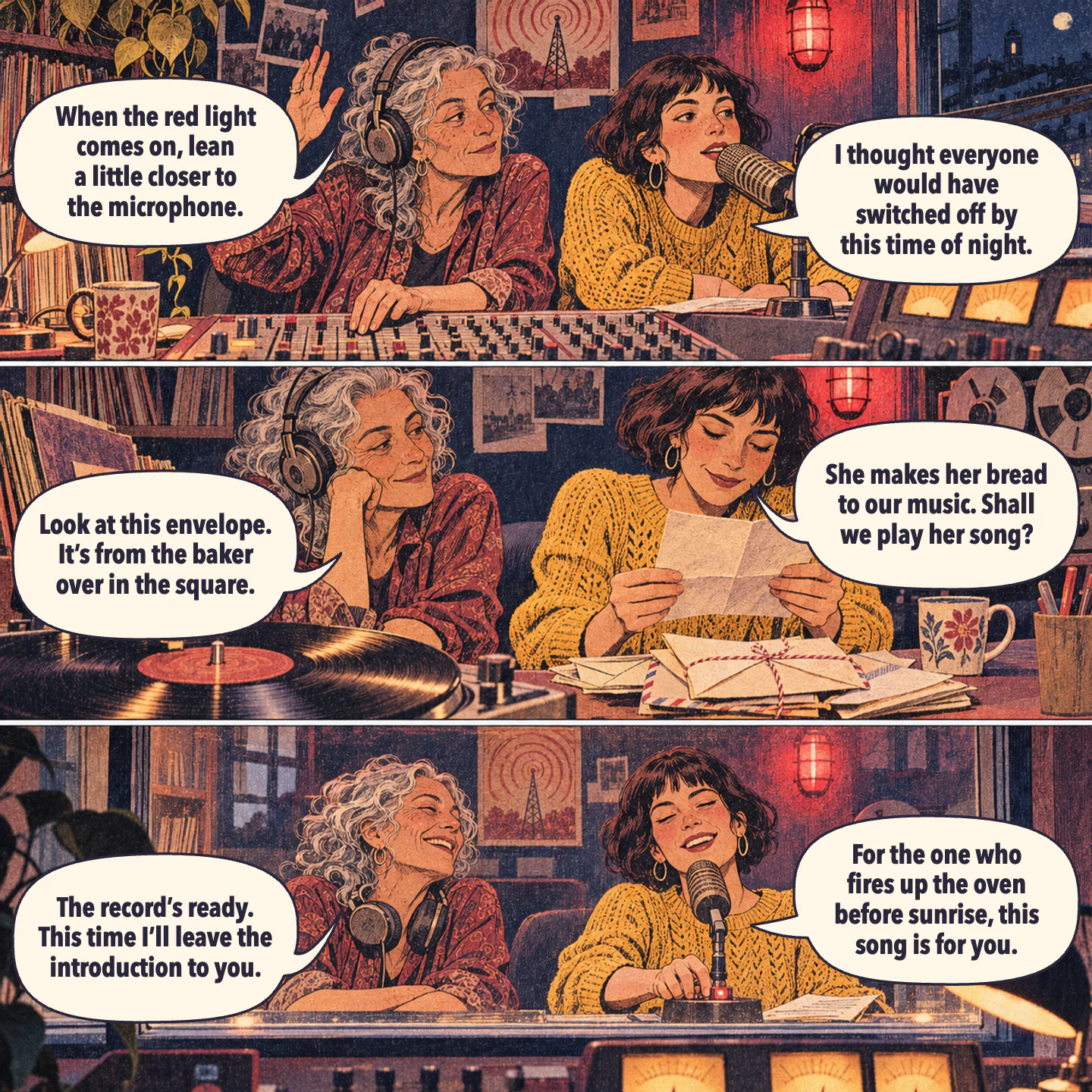
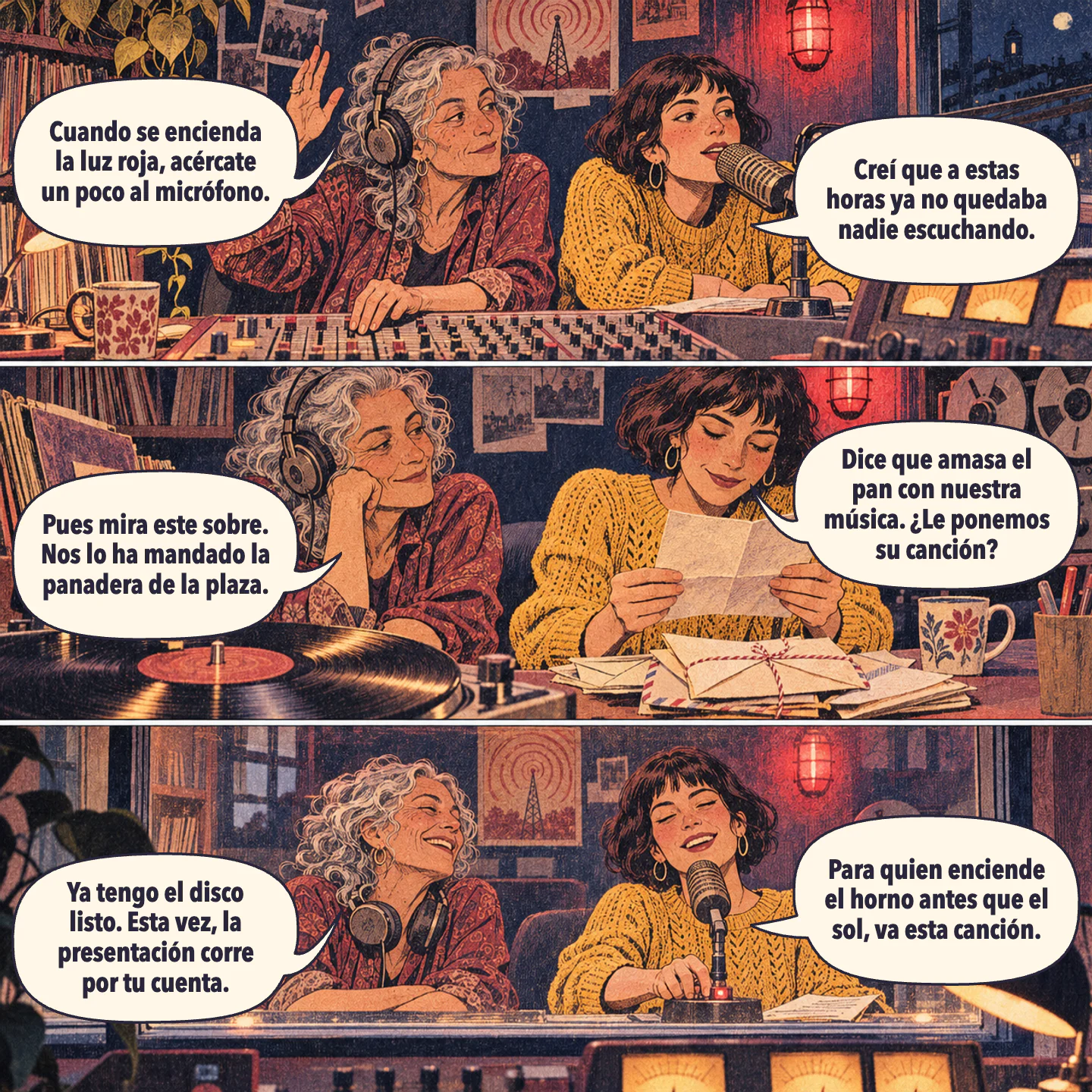
A song after midnight translated into English
A song after midnight in Spanish
Original · SpanishEnglish · Translated

A song after midnight · Panel 1 · Engineer

Cuando se encienda la luz roja, acércate un poco al micrófono.

When the red light comes on, lean a little closer to the microphone.

What one balloon leaves unsaid

A line can be perfectly legible and still need the previous speaker. Read these short phrases on their own, then check the detail that gives each one its meaning.

아직이요.
Not yet.
The question is whether the last train has left. The answer reassures the traveler that he can still catch it. Read the platform exchange →
C’est fait.
Got it.
The apprentice has just recorded the flashes. The phrase confirms the note is made before the apprentice points to the bay. Follow the lighthouse signal →
¿Le ponemos su canción?
Shall we play her song?
The envelope introduces the baker. The presenter offers a dedication to her listener, so the English needs both “we” and “her.” Read the listener’s letter →

Proofread a page in three passes

Use the canvas views like a letterer reviewing a proof. Small changes in a tail, a pause or a name can change who seems to be speaking.

Original
Follow each tail to its speaker. Note the order of the exchange and any name that appears twice.
Translated
Read the page aloud. Check that a whisper, a joke or a sudden interruption still sounds right.
Compare
Slide across hard-to-read balloons. Check the last word, punctuation and the art immediately around the lettering.

When a translated line reads strangely

Open the original at reading size and find the first place where the meaning changes. A missing letter, a missing panel and a confusing speaker call for different fixes.

A question sounds like a statement
Check the last character and punctuation in the source. For vertical Japanese, inspect the bottom of the leftmost column. Include that edge when you make a new crop.
The answer seems to come from the wrong person
Trace both tails and follow the panel order. Include the preceding question in your image, particularly when the reply has no written subject.
A long sentence loses its last words
Compare the final line of the original balloon with the translation. If the source is soft or clipped, use a sharper scan of the entire panel. For final lettering adjustments, open the downloaded PNG in an image editor.

Keep character names consistent in a manga translation

Each uploaded page is a separate translation. If you’re reviewing a chapter, jot down the recurring object, your chosen wording and the panel where the meaning is clearest. Keep those notes alongside your downloaded pages.

Reader’s notes from the lantern workshop

提手 → handle
The loop the apprentice points to in the first panel. Keep “handle” if it shows up again.
浆糊 → paste
The material brushed onto the bamboo in the second panel. “Paste” keeps the paper craft detail.
月牙 → crescent moon
The shape of the lit patch in the final panel. Preserve the image if a later character mentions the moon.

From one panel to a chapter

Select a group of pages and start the batch. Up to 3 uploads run at once. Use the filmstrip to review a finished page while the others continue. Each image has its own translation, so check names across scenes as you go.

One page uses 5 credits. New accounts start with 25 welcome credits. View pricing

Keep your finished pages

Download a translated PNG from the canvas. To take several pages with you, open My Works, select the translations and download them together as a ZIP.

Open My Works

Frequently asked questions

All topics

Adding pages

4 questions
Which comic files can I upload?

Choose JPG, PNG or WebP images. For a PDF, CBZ or CBR, export or extract the pages you want to translate first. Each image becomes a separate item on the canvas.

How large can a page be?

Each image can be up to 10 MB and 24 megapixels. For a very long webtoon, cut at the empty space between scenes so the lettering stays readable.

Should I split a two-page spread?

Keep it together if an exchange crosses the binding and the letters are clear. If each page has its own dialogue and the small print looks soft, use two higher-resolution images.

Bubbles & artwork

4 questions
What part of a comic does this translate?

It replaces readable dialogue inside speech and thought bubbles. Each translation belongs in the balloon where the character originally spoke or thought.

What happens to signs, narration boxes and sound effects?

Manga mode asks the translator to preserve artwork and text outside bubbles, including shop signs, rectangular narration boxes and hand-drawn sound effects. Use Image Translator when you also want those words translated.

Does it flip right-to-left manga into left-to-right pages?

The page keeps its original orientation and panel sequence. A Japanese comic still reads from the rightmost panel even if the words inside its balloons are now in English.

Will the line art look exactly the same?

The translator is instructed to keep line art, color and screentones in place. Fine details near lettering can vary in a generated image. Drag Compare across faces, balloon edges and patterned areas before saving.

Languages & lettering

4 questions
Which languages can I translate into?

Choose from English, Chinese (Simplified), Chinese (Traditional), Japanese, French, German, Spanish, Italian, Korean, Portuguese, Arabic, Bengali, Hindi, Indonesian, Russian, Thai, Turkish, Vietnamese. Set one target language for your current batch.

Can I translate a page with more than one source language?

Choose Auto detect to let the translator identify the language of each utterance. If a short or stylized line is misread on a page in one language, try setting the source explicitly.

Can the manga translator read vertical Japanese dialogue?

Yes, when the characters are legible. Include the whole balloon so the translator can follow its columns and rewrap the dialogue in the target language. Very small furigana and hand lettering need a closer check.

What happens to jokes, honorifics and character names?

The translator uses the exchange on the current page to choose a natural line. Check nicknames, puns and honorifics against the original, especially when a later page reveals their meaning.

Working with chapters

4 questions
Can I translate several comic pages together?

Yes. Select multiple files, choose your target language, then use the batch button. The bottom filmstrip lets you switch pages and inspect a finished translation while others are processing.

Does one page remember the previous page?

Each image is a separate translation task. Keep a conversation on one image when its panels share a scene, and compare recurring names across the chapter yourself.

What if a single page fails?

Select its thumbnail and read the message in the translation panel. Use Check translation for a pending task, or retry the affected page after correcting an input problem.

Can I translate the same page into another language?

Yes. Download the first version, choose a new target language and translate again. Each language version is billed separately and appears in My Works when it is ready.

Review & downloads

4 questions
How do I check who said a translated line?

Choose Compare and move the purple divider across the balloon. Follow its tail to the character, then read the nearby reply. Switch to Original or Translated for an unobstructed view.

Can I change the translated words or pick a font?

The result is a flattened image. For a manual wording or lettering change, download the PNG and open it in your preferred image editor.

Which format do I get when I download a page?

Download image saves the translated page as a PNG. The small previews in the filmstrip and My Works help you browse the pages.

Can I download several translated pages at once?

Open My Works, select the finished pages and choose Download selected. You’ll receive a ZIP containing the translated PNGs.

Account, credits & privacy

4 questions
Can I explore the translator before signing in?

Yes. Drag the dividers on the prepared examples or open a sample on the canvas. Sign in with Google when you’re ready to run a translation.

How many credits does a manga page use?

One page translated into one language uses 5 credits. New accounts receive 25 welcome credits. The batch button shows the cost before you start.

Does manga translation run entirely on my device?

File selection and preview happen in your browser. Starting a translation sends the page to the image translation service and stores the original and result so you can revisit your work.

Where can I find a page after closing the canvas?

Sign in with the same Google account and open My Works for your recent saved translations. Download the pages you want to keep as a permanent copy.

Try the manga translator on your comic

Bring a comic page or try one of the 5 illustrated examples.

Compare one panel at a time. Check who is speaking, whether the translated line fits the bubble and whether a sound effect belongs to the artwork. The manga translator produces a page image. OCR can also give you a separate transcript of the original dialogue.